In 2026 local SEO is no longer just a strategy, it is a credibility signal. In 2026 local SEO is no longer just a strategy, it is a credibility signal. Knowing how to build local business citations correctly is now essential for proving your business legitimacy across Google and AI-powered platforms like ChatGPT and Google SGE that your business is really trusted and ready for customers. From directories to niche industry sites every accurate citation strengthens your online authority boosts local rankings and drives real revenue. This guide walks you step by step through building a flawless citation profile that dominates both traditional search and AI powered local discovery
What Are Local Business Citations?
A local business citation is any online mention that includes your business Name, Address, and Phone Number, known as NAP, and understanding how to build local business citations correctly ensures this data stays consistent across platforms. Citations appear on directories, review platforms, mapping apps, social profiles, and industry portals. Each accurate citation sends Google one clear signal: this business is real, it operates at this address, and multiple independent sources confirm it consistently across the web.
In 2026, the strongest citations go beyond NAP. Complete citations include website URL, business hours, keyword-rich description, business categories, customer reviews, and professional photos. SEO professionals now call this expanded footprint NAPW, which represents the full digital fingerprint Google uses to verify your business identity with maximum confidence across every platform that matters.
Why Do Citations Directly Control Your Local Google Rankings?
Google ranks local businesses on three core factors: Relevance, Distance, and Prominence. Citations are the primary driver of Prominence, which measures how well-established your business appears across the entire web, especially for businesses that build local business citations with accurate and consistent data. Whitespark’s 2026 Local Search Ranking Factors report, compiled from 47 global SEO experts, confirms citation signals account for 7% of total local ranking influence across both Local Pack and Local Organic results.
The numbers tell the real story. Businesses with 10 accurate, high-authority citations consistently outrank competitors carrying 200 low-quality inconsistent ones. A dental clinic listed on the American Dental Association, Zocdoc, and Healthgrades generates actual patient bookings, not just ranking improvements. Citation quality is a direct revenue decision, not a technical SEO checkbox.
How Do Citations Drive AI Search Visibility in 2026?
Google SGE, ChatGPT, and Perplexity do not guess which businesses to recommend. They validate businesses by cross-referencing NAP data across multiple trusted sources to build entity confidence, which is the AI system’s certainty that your business is real and genuinely relevant. Without consistent citations across authoritative platforms, especially when businesses fail to build local business citations correctly, AI tools encounter conflicting signals and default to better-documented competitors in AI-generated local answers.
The 2026 Whitespark study confirms citations rank third in AI Search Visibility factors at 13% overall influence, with three of the top five AI visibility factors being directly citation-related. This channel barely existed three years ago and is now growing faster than traditional organic search for local queries. Businesses investing in citation accuracy today are building AI visibility that most competitors have not yet realized they are actively losing ground on.
What Is NAP Consistency and Why Does One Mistake Cost You Rankings?
NAP consistency means your Name, Address, and Phone Number are identical on every platform without exception. Google reads “123 Main St.” and “123 Main Street” as two different addresses. One conflict creates doubt, and that doubt suppresses rankings across traditional and AI search simultaneously. Create a Master NAP Document before building any citation and treat it as the only reference for every listing you ever create or update.
The most common NAP errors destroying local rankings silently every day are the following:
| Wrong Format | Correct Format | Impact on Rankings |
| 123 Main St. | 123 Main Street | Treated as completely different addresses |
| Ste 4 vs Suite 4 | One permanent format only | Creates duplicate conflicting entity signals |
| Joe’s Plumbing LLC vs Joes Plumbing | Exact legal business name always | Google cannot confirm same entity |
| (555) 123-4567 vs 5551234567 | One consistent format everywhere | Phone variations split citation authority |
| New York, NY vs New York | Always include state abbreviation | Creates geographic ambiguity in algorithm |
What Is the Difference Between Structured and Unstructured Citations?
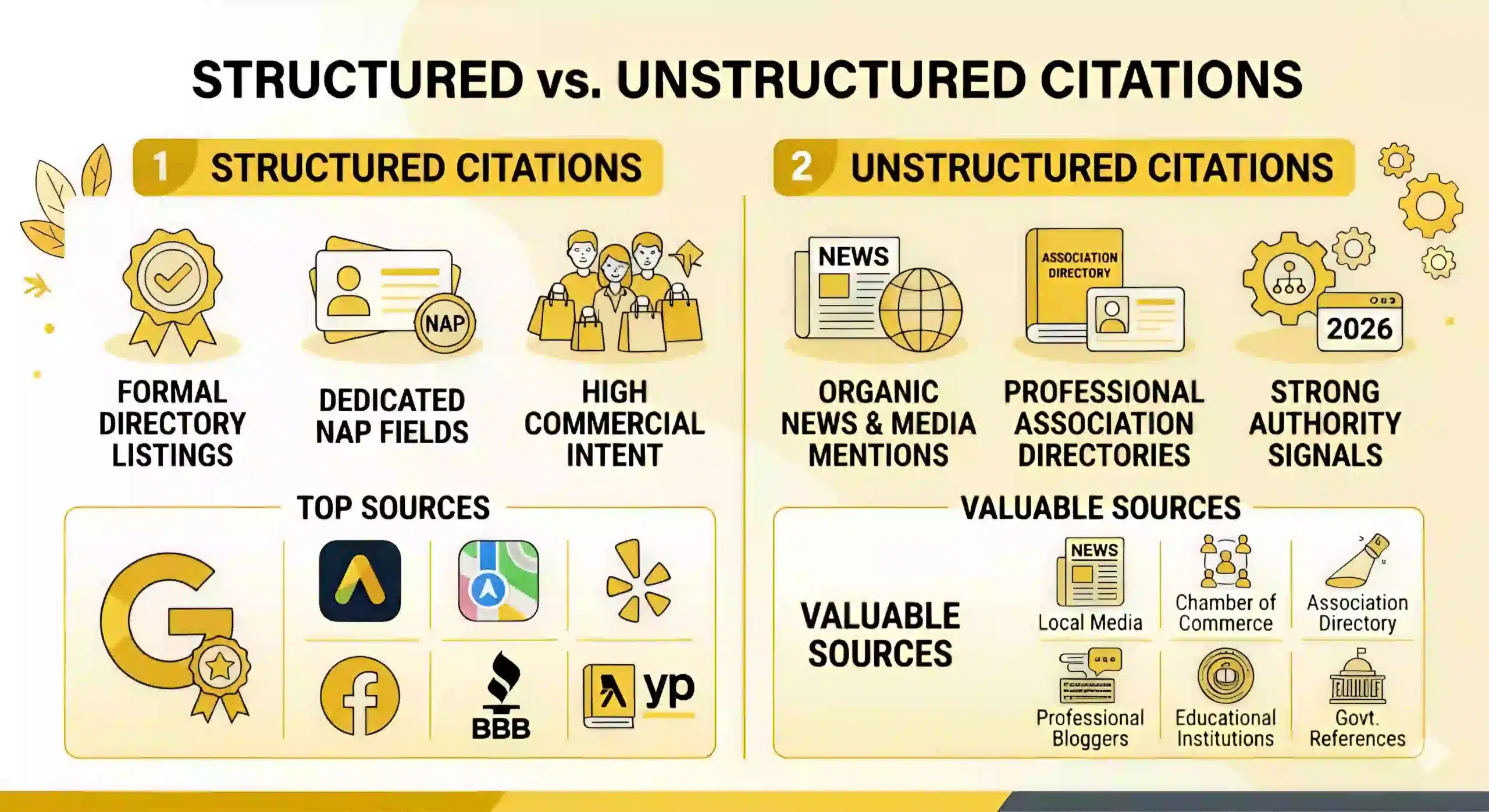
Structured Citations
Structured citations are formal directory listings with dedicated NAP data fields on platforms built specifically for local business discovery. They drive direct commercial traffic because users visit these platforms with explicit buying intent. The most valuable structured citation sources include the following platforms:
- Google Business Profile, the single most important citation you own
- Apple Business Connect, powering all Apple Maps and Siri local results
- Yelp, the dominant review and local discovery platform
- Facebook Business Page, a high-authority social citation
- Better Business Bureau, a critical trust signal for customers and search engines
- Yellow Pages YP.com, legacy authority still valued by all major aggregators
Unstructured Citations
Unstructured citations are organic NAP mentions inside regular web content including news articles, blog posts, and professional association directories. Google’s 2026 algorithm weights these heavily as genuine authority signals impossible to manufacture at scale. The most valuable unstructured citation sources are the following:
- Local newspaper and media websites covering your business
- Industry association member directories and spotlights
- Chamber of commerce member features and newsletters
- Professional blogger reviews and recommendations
- Government and educational institution references
One mention in a respected local publication outweighs ten submissions to low-authority general directories. A complete strategy builds both types with deliberate intention. To build local business citations effectively, you need a clear structure and execution plan.
How to Build Local Business Citations Step by Step

Building citations without a priority hierarchy creates inconsistencies that are expensive to fix later, making Local Citation Building an essential step for every business. The professional sequence starts with the most authoritative sources first and expands outward once the core presence is solid and verified.
Tier 1: Google Business Profile
Complete every available field, upload professional photos, select accurate primary and secondary categories, and keep it updated at all times. Your GBP is the reference point Google uses to validate every other citation it finds about your business across the web.
Tier 2: Core National Platforms
| Platform | Primary Strength |
| Apple Business Connect | Powers Apple Maps and all Siri local results |
| Bing Places for Business | Over 100 million daily active users |
| Facebook Business Page | High-authority social citation valued by Google |
| Yelp | Dominant review and local business discovery platform |
| Better Business Bureau | Critical trust signal for customers and search engines |
| Yellow Pages YP.com | Legacy authority valued by all major data aggregators |
| Foursquare | Feeds citation data to over 200 downstream platforms |
| Nextdoor | Hyperlocal community reach across 42 million households |
Tier 3: Data Aggregators
After Tier 2 is complete, submit to major data aggregators for automated mass distribution across hundreds of platforms simultaneously, supported by professional Business Listings Management to ensure consistency and accuracy.. Full details in the next section.
Tier 4: Industry-Specific and Local Directories
Niche and location-specific directories deliver the strongest relevance signals in your entire strategy. Full details in the dedicated section below.
What Are Data Aggregators and How Do They Multiply Your Reach?
Data aggregators collect verified business information and distribute it automatically to hundreds of websites, making them a key step when you build local business citations at scale, apps, mapping platforms, and GPS databases simultaneously. The major US aggregators are Foursquare, Neustar/Localeze, and Data Axle. One accurate submission reaches platforms you would never reach through manual work alone, making aggregators the highest-leverage tool to build local business citations for reach per hour of effort invested.
The critical rule before any aggregator submission is this. Your NAP must be verified and perfect first. Inaccurate data submitted to an aggregator does not create one wrong listing. It propagates that error automatically across hundreds of platforms, creating a cleanup problem that takes months to fully resolve. Perfect your Master NAP Document, verify Tier 1 and Tier 2 are accurate, then submit to aggregators with complete confidence in your data.
Which Industry-Specific Directories Deliver the Strongest Results?
One authoritative niche directory listing consistently outperforms ten general directory listings in relevance signal strength, especially when you build local business citations with a focus on industry relevance. A healthcare client who built citations through local health insurance provider directories saw a 40% increase in local pack appearances within 90 days. Niche citations send Google a focused, unambiguous signal about exactly what your business does and who it genuinely serves.
The most impactful niche directories by industry category are the following:
| Industry | Top Niche Directories |
| Healthcare | Healthgrades, Zocdoc, WebMD, Vitals |
| Legal | Avvo, FindLaw, Justia, Martindale-Hubbell |
| Dental | American Dental Association, 1-800-Dentist, Zocdoc |
| Home Services | Angi, HomeAdvisor, Houzz, Thumbtack |
| Restaurants | TripAdvisor, OpenTable, Zomato, MenuPages |
| Real Estate | Realtor.com, Zillow, Trulia, Homes.com |
| Automotive | Cars.com, AutoTrader, CarGurus, DealerRater |
| Hospitality | TripAdvisor, Booking.com, Expedia, Hotels.com |
| Software and SaaS | Capterra, G2, GetApp, Trustpilot |
| Weddings | WeddingWire, The Knot, Zola |
How Do You Find Every Directory Your Competitors Are Listed On?
Instead of guessing which directories matter in your specific market, reverse-engineer exactly where your best-ranking competitors are listed and replicate those sources systematically. Two proven methods deliver comprehensive competitive intelligence at zero cost.
Method 1: Google Search Operators
Type this exact query into Google:
“[Competitor Business Name]” -site:[competitor domain] -site:[competitor social handle]
This returns every third-party page mentioning your competitor outside their own properties. Each result is a direct citation opportunity you can pursue immediately. Among the results you will consistently find the following:
- Location-specific local directories
- Industry association member listings
- Regional business portals and local guides
- Chamber of commerce directories
- Niche review platforms specific to your market
Method 2: Backlink Gap Analysis
Enter your domain alongside four competitor domains in Semrush’s Backlink Gap tool. The output shows every site linking to your competitors but not to you. Filter the results specifically for directories and local portals and you will have a complete, market-tested citation target list built on real competitive intelligence rather than generic recommendations.
Is your citation profile holding your rankings back without your knowledge?
Most businesses discover years of inaccurate, incomplete, and duplicate listings accumulated without their awareness. At Citation Building Group, we conduct professional citation audits that identify every listing harming your local rankings and deliver a complete remediation plan backed by proven local SEO expertise.
Get your free citation audit today with Citation Building Group
How Do You Build Local Business Citations Manually?
Manual citation building requires a disciplined, consistent process. Rushing through submissions or skipping optional profile fields creates the exact inconsistencies that silently undermine your strategy over time.
The Complete Manual Citation Building Process
Follow these steps in order for every directory you submit to:
- Create your Master NAP Document containing exact business name, full address, primary phone number, website URL, business email, hours of operation, keyword-rich description, and chosen categories.
- Set up a dedicated business email address for all directory registrations to keep account management organized and separate from primary business communications.
- Search each target directory first to confirm no existing profile for your business already exists before creating a new one.
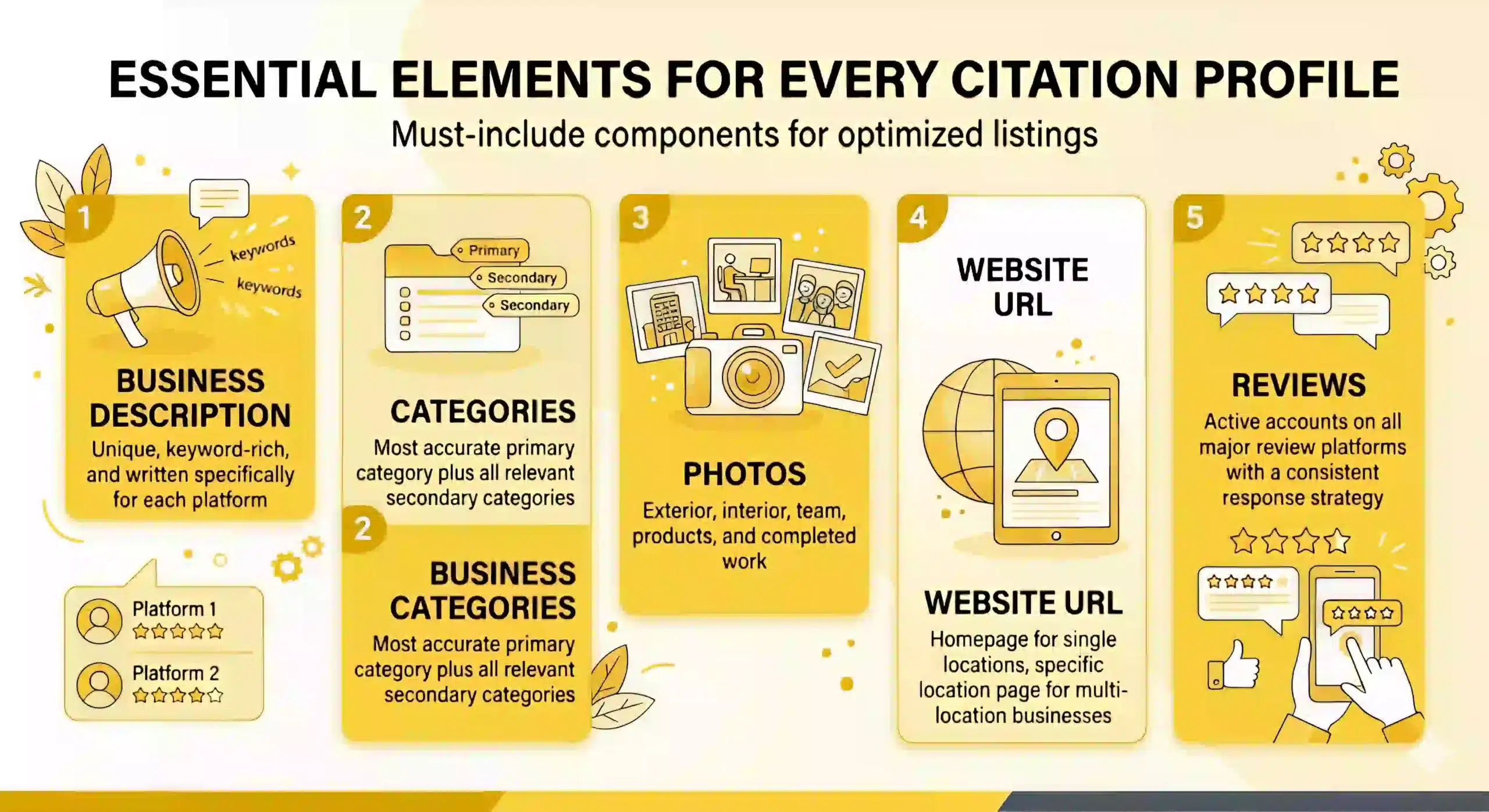
- Complete every available profile field including optional fields like description, photos, categories, and hours, not just mandatory NAP fields.
- Record every submission in a Citation Tracking Spreadsheet with platform name, profile URL, username, password, submission date, and current live status.
What to Include in Every Citation Profile
What Is the $0.50 Per Citation Outsourcing Method?
To build local business citations is repetitive, process-driven, and perfectly suited for outsourcing to trained freelancers at a fraction of traditional agency rates. This method was documented by a marketing consultant with eight years of agency experience and delivers one of the highest ROI outsourcing opportunities available to small business owners and local SEO agencies.
How to Implement the $0.50 Method Step by Step
Follow this exact process to outsource citations efficiently without sacrificing quality:
- Post a job on Upwork titled “Local SEO Citation Building” targeting experienced citation specialists.
- Screen applicants using three non-negotiable criteria:
- Job Success Score above 90%
- Minimum 500 hours worked on the platform
- Reviews specifically mentioning citation building or local SEO work
- Hire individual freelancers rather than contracting agencies. Individuals deliver more consistent quality at significantly lower cost per citation.
- Negotiate a flat rate of approximately $50 for 100 citations and place payment in escrow before work begins.
- Provide a complete project brief including your Master NAP Document, target directory list, and Citation Tracking Spreadsheet template.
- Review deliverables before releasing payment by verifying live links and confirming a representative sample against your Master NAP Document.
What the Contractor Must Deliver
Before releasing any payment, confirm the deliverable includes all of the following:
- Direct live links to every completed listing
- Username and password for every account created
- Completed Citation Tracking Spreadsheet with all submissions recorded
- Screenshots or confirmation of any listings requiring verification steps
Managing citation building manually across dozens of platforms is a time-intensive process most businesses cannot sustain alongside core operations. At Citation Building Group, our team of SEO citation builders handles the entire process from audit through aggregator distribution, niche directory submissions, and ongoing management. Our white-label service lets agencies deliver professional citation results under their own brand with full transparency and reporting, highlighting key Citation Building Service Features that make every submission accurate and effective..
Build local business citations that rank with Citation Building Group
How Do You Audit and Fix Your Existing Citations?
A citation audit uncovers inaccurate, inconsistent, and duplicate listings actively suppressing your rankings. For most businesses operating more than two years without active citation management, audit findings are substantial. The audit is the required foundation that determines how much value every new citation you build will actually deliver.
The Complete Citation Audit Process
Work through these steps in sequence for maximum impact:
- Compile your full citation inventory using BrightLocal Citation Tracker, Semrush Listing Management, or Moz Local combined with manual Google searches for all business name and address variations.
- Compare every found listing against your Master NAP Document and flag each one as Accurate, Inaccurate, Incomplete, or Duplicate.
- Prioritize fixes by platform authority starting with Google Business Profile, then Apple Maps, then Bing Places, then Yelp and Facebook before addressing smaller directories.
- Claim and correct inaccurate listings directly through phone, postcard, or email verification on each platform.
- Request duplicate removal from each directory’s support team rather than simply editing one and leaving the other active.
Best Citation Management Tools in 2026
| Tool | Best For | Key Strength |
| BrightLocal | Agencies and multi-location businesses | Full management with human verification |
| Semrush Listing Management | Businesses already using Semrush | Integrated with full SEO platform and GBP |
| Moz Local | Aggregator-focused distribution | Direct connections to all major US aggregators |
| Whitespark Citation Builder | Niche and location-specific directories | Hybrid automation plus human builders |
How to Track Citation ROI
Measuring citation ROI requires consistent monitoring across multiple channels simultaneously. The key metrics to track are the following:
| Channel | Key Metrics |
| Google Business Profile Insights | Profile views, direction requests, website clicks, calls |
| Google Analytics | Referral traffic from Yelp, YP, BBB, and citation sources |
| Bing Places Insights | Views, visits, calls, direction requests |
| Local Rank Tracker | Local pack position for target keywords monthly |
| Directory Dashboards | Yelp, YP, and BBB profile engagement and actions |
Secure Your Business’s Top Local Rankings Now
Your local competitors build local business citations every day. Every day without an accurate, consistent citation profile is a day your rankings and revenue are going to someone else. At Citation Building Group, we have built and managed thousands of citation profiles across every industry and competitive market. We handle everything from initial audit and duplicate cleanup through new citation building, aggregator distribution, niche directory submissions, and ongoing management. Our work is transparent, our reporting is clear, and our results are proven.
Contact Citation Building Group today and claim your free citation audit at Citation Building Group
Conclusion
Your competitors build local business citations every day and every missed opportunity is a potential customer lost. By mastering local citations in 2026 you secure higher Google rankings and unmatched visibility in AI search results. From perfect NAP consistency to strategic placement across authoritative platforms a well executed citation strategy transforms your online presence into measurable growth. Start building auditing and optimizing your citations today and turn your business into the most trusted choice in your local market
FAQs
Are citations still important for local SEO in 2026?
Citations are more critical in 2026 than at any previous point. They account for 7% of local pack ranking signals per Whitespark’s 2026 study and rank third in AI Search Visibility factors at 13% influence. Citation accuracy is now essential for visibility across both traditional Google search and AI-powered discovery tools including Google SGE, ChatGPT, and Perplexity.
How many citations does my business need?
Quality consistently outperforms quantity. Ten high-authority, fully accurate citations outrank fifty inconsistent low-quality ones every time. Build Tier 1 and Tier 2 platforms first, then expand to niche directories and aggregators. The average local business has approximately 80 citations but accuracy, consistency, and source authority matter far more than volume.
Can low-quality citations hurt my rankings?
Yes. Listings on spammy or irrelevant directories deliver no positive ranking value and actively damage your credibility in Google’s quality assessment. Conduct a citation audit evaluating domain authority and relevance for every platform where your business appears and request removal from any directory below a reasonable quality standard for your industry.