Your business is listed on Google, Yelp, Facebook, and a dozen other directories. You set those listings up once, years ago, and moved on. Right now, at this very moment, some of those listings are showing the wrong phone number. Some are showing an old address. Some have been duplicated by data aggregators and are contradicting each other across the web. Every single one of those errors is costing you rankings, customers, and revenue. Local citation management is the process that fixes this, prevents it from happening again, and turns your digital presence from a liability into a competitive weapon.
What Is Local Citation Management and Why Is It Never a One-Time Task?
Local citation management is the ongoing process of monitoring, updating, and correcting your business’s core information across all online directories and platforms. The key word is ongoing. Building your initial listings is only the beginning. Over time, your data changes, directories pull incorrect information from other sources, competitors or members of the public can edit certain listings, and duplicate entries appear without warning.
A citation is any online mention of your business’s Name, Address, and Phone Number, commonly referred to as NAP. These mentions appear on business directories, review sites, social media profiles, industry-specific platforms, and news articles. Citation management for local SEO is the discipline of ensuring every single one of those mentions is accurate, consistent, and working in your favor rather than against you.
Why Does NAP Consistency Make or Break Your Local Rankings?
NAP consistency is the golden rule upon which all local search success rests. Google uses your business information across the web to verify that your business is legitimate and actually located where you claim. When that information is consistent across multiple reputable sources, Google’s confidence in your listing increases and your rankings improve. When it is inconsistent, Google treats your data as unreliable and ranks you lower.
The impact is not theoretical. Research shows that citation signals are among the most important local ranking factors, helping businesses perform up to 18 times stronger in online search compared to businesses with inconsistent or incomplete citation profiles. Any variation in your NAP, no matter how minor, sends conflicting signals that confuse search engines and directly erode the trust they place in your business listing.
The customer experience suffers equally. Consider a consumer searching for a local business and receiving different addresses from different sources. Most of those consumers will simply choose a competitor with consistent information rather than try to track down which listing is correct. Inconsistent local citation management does not just hurt rankings. It actively drives paying customers to your competition.
What Is the Difference Between Structured and Unstructured Citations?
Understanding the two types of citations is essential to building a complete citation management for local SEO strategy. The following describes each type:
- Structured citations appear in business directories and review sites where your data is entered into specific, organized fields. Your listing on Yelp, Google Business Profile, or Facebook are all structured citations where NAP data sits in defined database fields.
- Unstructured citations consist of mentions of your business name, address, or phone number within the body of written content, such as a local news article, a blog post, or a community forum thread.
Both types influence your local authority and both require active monitoring. Structured citations carry more direct ranking weight, but unstructured citations build credibility and trust signals that reinforce your overall local SEO profile.
What Are the Three Approaches to Local Citation Management?

There is no single approach to local citation management that fits every business. The right method depends on your budget, the size of your business, and the number of locations you manage. Here is a complete breakdown of all three options:
| Approach | Best For | Key Advantage | Key Risk |
| Manual | Small businesses, single location | Maximum control and permanent listings | Extremely time-consuming |
| Semi-automated | Small to large businesses | Efficiency in finding errors | Corrections still require manual work |
| Fully automated | Multi-location, enterprise, agencies | Fastest and broadest coverage | Listings may revert if subscription cancelled |
Manual Citation Management
The manual approach involves Build Local Business Citations, editing, and managing every citation yourself using a spreadsheet to track all listings. You individually visit each directory, claim your listing, correct errors, remove duplicates, and create new entries by hand. This approach gives you maximum control and ensures every listing is permanent and fully owned by you, with no dependency on third-party subscriptions.
Manual citation management for local SEO is appropriate in two specific scenarios: a startup with more time than budget that needs to handle everything independently, and any business that uses an automated service for core platforms but wants to supplement it by building additional citations on geo-specific or industry-specific directories not covered by that service. The primary drawback is the volume of time required. Even a single-location business must commit to hours of initial work and ongoing maintenance.
Semi-Automated Citation Management
The semi-automated approach uses software tools such as Moz Local, BrightLocal, or Whitespark to automatically scan the web, identify all existing listings, and flag inconsistencies and errors. The tool finds the problems. You or your team still visit each directory and make the corrections manually. This combines the efficiency of automated auditing with the accuracy of human repair.
This approach works well for small to large businesses when pricing is appropriate and service quality is high. The important caveat is that many semi-automated services provide a one-time citation build but charge again when data becomes inaccurate later. Local citation management is not a set-and-forget activity, and any service that treats it as one is not providing genuine ongoing protection for your rankings.
Fully Automated Citation Management
The fully automated approach uses services that distribute your business information to a network of data aggregators and directories from a central dashboard. You submit your correct NAP once and the service syncs it across its entire partner network. Platforms like Yext, Uberall, and BrightLocal offer powerful solutions of this type with centralized dashboards that let you see and update your information across hundreds of directories simultaneously.
The scale of the problem this solves is significant. The Moz Local team discovered that the average enterprise has between 3,500 and 10,000 duplicate local business listings. Addressing that manually would require 44 weeks of work per year. Automation reduces the same task to a matter of minutes. However, the critical risk of fully automated solutions is the subscription dependency. If you cancel your subscription with services like Yext, your listings may revert to their previous incorrect state. Manual building through a specialized service creates permanent listings that no cancellation can undo.
Before choosing an automated solution, research whether the platform permanently closes duplicate listings or simply suppresses them, and investigate what happens to your citations if you end the service. Not all automated platforms are equal in quality, and some inflate their offering with low-quality directories that contribute nothing to your rankings or reputation.
How Many Citations Does a Business Actually Need?
There is no universal answer to this question, but research provides clear guidance. A bakery in a small town may need as few as 20 solid citations to dominate its local market. An auto dealership in Los Angeles will need considerably more to compete. One of the most comprehensive citation studies in recent years found that businesses of all sizes tend to see the best return on investment from building approximately 30 to 40 high-quality citations. Industry research also identifies 35 directories as the sweet spot for optimal local search performance and engagement.
Going beyond that number without purpose is wasteful. Building citations on irrelevant, low-quality directories simply to inflate your count does not improve rankings and can dilute the quality signals you are sending to search engines. The goal is not the highest possible number of citations. The goal is the right citations, on the right platforms, with perfectly consistent information.
If your business is currently underperforming in local search and you are unsure whether your citation profile is the cause, a professional audit is the fastest way to find out. Citation Building Group offers a Free Citation Audit that shows you exactly which listings are incorrect, duplicated, or missing before you invest in any new campaigns.
How to Conduct a Citation Audit Before Choosing a Management Strategy?

Before managing your citations, you must understand your current situation. A proper audit before committing to any local citation management strategy follows these steps:
- Define the single official version of your NAP data that will serve as your master reference for all listings going forward
- Use specialized tools and manual searches to find every existing citation for your business across the web
- Document every listing you find in a spreadsheet, noting inconsistencies, errors, and duplicates
- Identify which listings you own and have claimed, and which have been auto-generated by data aggregators
- Prioritize corrections starting with the highest-authority platforms and working downward
This foundational audit is not optional. Any citation management for local SEO strategy built without it is built on unknown ground, and that unknown ground may already be working against your rankings.
What Are the Top Citation Sources Every Business Must Manage?
Focusing your local citation management efforts on the highest-authority platforms first maximizes the impact on your local rankings. The essential platforms every business must prioritize are organized by category:
- Core platforms: Google Business Profile, Facebook, Apple Maps, and Bing Places form the indispensable foundation of any citation strategy
- High-authority general directories: Yelp, Yellow Pages, Foursquare, Better Business Bureau, MapQuest, and TomTom provide broad visibility across the most trusted third-party sources
- Industry and geo-specific directories: Local chamber of commerce websites, industry association directories, and city-specific business guides provide the niche authority signals that reinforce your relevance in your specific market
Beyond these foundational sources, the most valuable citation sources for your specific business depend on your industry and geography. Use a local citation finder tool to identify the top citation sites in your country and industry category, and always check which directories your top local competitors appear in to ensure you are not missing any platform where your business should be listed.
Why Is Ongoing Citation Management Necessary Even When Nothing Changes?
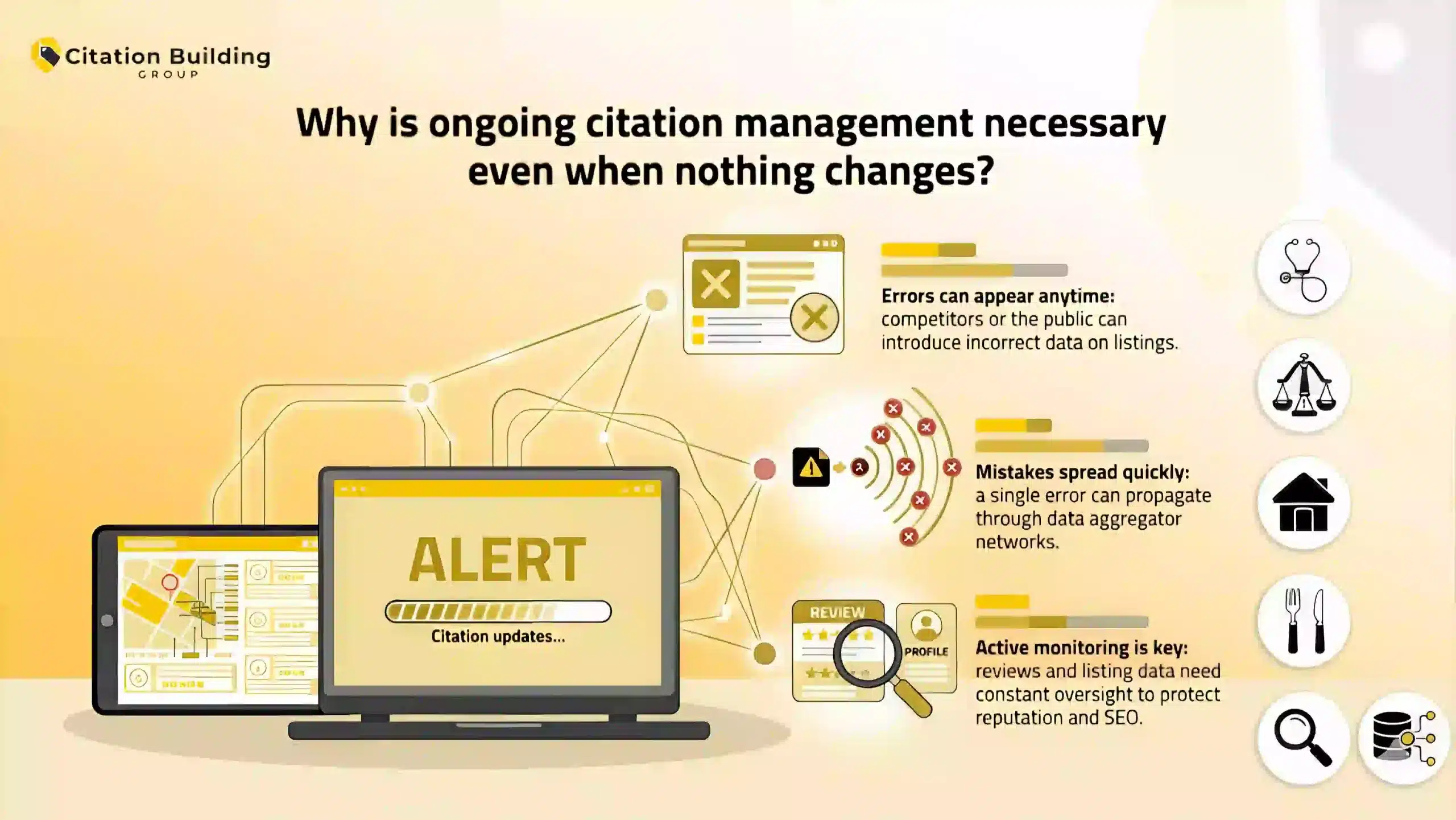
Many business owners assume that once their citations are clean and consistent, the work is done. This assumption is one of the most costly mistakes in local SEO. Local citation management requires continuous attention for several reasons that apply to every business regardless of size or stability.
First, competitors and members of the public can edit certain local business listings on platforms that allow crowdsourced updates, enabling incorrect data to be published about your business without your knowledge.
Second, inaccurate data in one place naturally flows downstream to others through data aggregator networks, so a single error can multiply across dozens of platforms if not caught early.
Third, most major citation platforms incorporate customer reviews into your business listings, and those reviews require active monitoring and response to protect your reputation and local authority.
The businesses that treat citation management for local SEO as a continuous practice rather than a one-time fix maintain cleaner citation profiles, respond faster to data corruption, and consistently outperform competitors who take the passive approach to their digital presence.
What Is Active vs Passive Citation Management and Which One Wins?
Active local citation management means taking deliberate control of how your business is represented across the web. It includes applying for accurate citations on major platforms, increasing discoverability by expanding to additional relevant directories, managing and removing duplicate or inaccurate listings, monitoring and responding to reviews, and building strategies for future data changes such as moving to a new address, rebranding, or changing phone numbers.
Passive management means taking a hands-off approach and allowing data aggregators to populate your citations automatically without oversight. The risks of passive management include having no system to discover inaccuracies or reviews, having no strategy to handle data changes, accumulating low-quality or duplicate citations, and losing control over how your business appears online. Users and other businesses can even falsify your listings with incorrect information if no active monitoring system is in place.
Active management wins every time. The difference in local search performance between businesses with active and passive citation management for local SEO strategies is not marginal. It is the difference between appearing on the first page and being invisible to the customers who are actively searching for what you offer.
How to Build a Strong Citation Profile From Scratch?
For businesses starting from zero, building a strong citation foundation before focusing on ongoing management follows this process:
- Create your Google Business Profile and ensure it is 100% complete with photos, hours, description, and all available fields filled in
- Compile your official NAP data into a single reference document and use it without variation for every submission going forward
- Register your business in all major general directories, filling in every available field with rich, consistent information
- Use a domain-based email address when applying for citations to signal greater business legitimacy to directory platforms
- Identify directories specialized in your industry and geographic area and submit to the most authoritative ones
- Claim and verify your listings on every platform that offers verification, as verified listings carry greater trust and ranking weight
- Track every listing you create in a spreadsheet that includes the directory name, listing URL, login details, and current status
Providing rich information beyond basic NAP data, including operating hours, a thorough business description, your logo, photos, and services, strengthens your citation profile and improves the quality signals each listing sends to search engines.
What Are the Best Tools for Local Citation Management?
Several platforms offer powerful solutions for businesses and agencies managing citations at scale. The leading tools for local citation management include:
- Moz Local: Automated distribution and duplicate listing closure across a broad network of partner directories, with dashboard visibility across all listings
- BrightLocal: Comprehensive citation auditing, tracking, and building with strong reporting capabilities for agencies
- Yext: Real-time sync across a large partner network with powerful dashboard controls, operating on a subscription model
- Uberall: Multi-location management with centralized updates that distribute changes across all channels simultaneously, reducing a multi-hour manual task to a single five-minute update
- Whitespark: Specialized citation building and local citation finder functionality with strong geo and industry-specific directory coverage
When evaluating any tool, research whether it permanently closes duplicate listings or simply suppresses them, what happens to your citations if the subscription ends, and whether the platform’s partner directory network prioritizes quality over quantity.
What Are the Latest Trends Shaping Citation Management for Local SEO in 2026?

Local citation management is evolving rapidly alongside changes in how people search for local businesses. The trends reshaping citation strategy in 2026 include several significant developments.
Voice Search Optimization
With Google Assistant, Siri, and Alexa increasingly used for local queries, your business descriptions, categories, and NAP details must reflect how people speak naturally in conversational queries, not just how they type. Optimizing for voice search gives visibility in a channel most competitors are ignoring.
Hyper-Localized Content
Google emphasizes geo-targeted results. Incorporating localized keywords, landmarks, and neighborhood-specific info into your listings improves relevance for street- and neighborhood-level searches, not just city-level searches.
AI-Powered Local Search
Tools like ChatGPT, Google SGE, and other AI assistants now use citation data to answer local queries. Maintaining a clean, consistent, and complete citation profile increases the chance AI tools surface your business accurately, making citation management for local SEO essential for both traditional search and AI-driven discovery.
Start Improving Your Citations Today
As professional citation builders, Citation Building Group has spent over 10 years building and managing citations for local businesses and agencies across the USA, Canada, the UK, and Australia. Our team handles every aspect of local citation management manually, creating permanent listings that no subscription cancellation can undo. Detailed reports are delivered within 7–14 days.
Don’t wait and start your Free Citation Audit now and see exactly where your citation profile stands before launching your next campaign.
Conclusion
Your competitors are not just outranking you because they have better products or bigger budgets. In many cases, they are outranking you because their business information is consistent, complete, and actively managed across the web while yours is not. That is a fixable problem, and fixing it delivers results that every other marketing investment you make will benefit from.
FAQs
What is the biggest risk of poor local citation management?
The biggest risk is providing Google with conflicting business information, which undermines trust and lets competitors outrank you. Inaccurate data spreads through aggregator networks, compounding the problem. Poor local citation management not only hurts rankings but also drives customers to your competitors.
How often should I audit my citations?
Conduct a comprehensive audit at the start of any local citation management strategy, then schedule reviews every 6–12 months. Audit immediately after any changes to your business details. Citation Building Group’s Free Citation Audit helps identify errors and shows exactly which listings need correction before they impact your rankings.
What is the difference between Yext and manual citation building?
Yext uses a subscription model, so if you stop paying, listings may revert to incorrect data. Manual local citation building through services like Citation Building Group creates permanent listings that aren’t affected by cancellations, making it a more stable and cost-effective option for long-term local SEO.
What should I do first if my business moves to a new location?
Start by immediately updating your Google Business Profile, then fix your listings across high-authority platforms in an organized way. Ensure your official NAP data is consistent everywhere, as outdated or mismatched information can harm your local rankings and mislead customers.