
AI Citation Building Tools: Best Options, Benefits, and Risks for Local SEO

AI citation building tools are changing how businesses manage online listings, monitor brand visibility, and identify opportunities across search engines and AI-powered platforms. Instead of checking every directory manually, businesses can use automation and AI-assisted research to organize information, identify inconsistencies, and track where their brand appears. However, not every citation tool serves the same purpose. Some platforms distribute business information across directories, others analyze which websites AI search engines reference, and some generate academic citations for research papers. Understanding these differences is essential before investing in software. For local businesses, the goal is not simply to create more citations. It is to maintain accurate business information, earn visibility on relevant platforms, and make it easier for customers to find trustworthy details. This guide explores the best options available, explains the benefits and limitations of artificial intelligence in citation management, and shows when professional manual submissions remain the better choice. What Are AI Citation Building Tools? AI citation building tools are software solutions that use artificial intelligence, automation, or data analysis to support citation-related tasks. The term covers three different activities. 1. Local Business Citation Building In local SEO, a citation is an online mention of a business, typically containing its name, address, and phone number (NAP). These mentions appear on business directories, review platforms, mapping services, and industry-specific websites. Citation management platforms can help businesses discover existing listings, distribute approved information, monitor inconsistencies, and maintain records across multiple locations. For a detailed explanation of the submission process, explore our local citation building guide. 2. AI Search Citation Tracking AI-powered search platforms, including ChatGPT, Perplexity, and Google AI Overviews, may reference websites when generating answers. An AI search citation occurs when an answer identifies a webpage or source supporting information presented to the user. AI citation tracking platforms help marketers understand which domains receive citations, how frequently their pages appear in monitored answers, and which competitors receive greater visibility. These tools monitor AI search visibility. They do not necessarily create local business directory listings. 3. Academic Citation Generation Academic citation tools help researchers format references using styles such as APA, MLA, and Chicago. An AI citation generator may help locate relevant publications, organize reference information, or prepare formatted bibliographies. However, academic references are fundamentally different from local business citations. A company looking to improve its Google Maps presence would not benefit from generating academic references for its business. Why Are AI Citation Building Tools Important for SEO? Businesses operating across several online platforms face a recurring challenge: their information changes, but the websites displaying that information do not always update simultaneously. A company might change its phone number on its website while older details remain visible on regional directories. For businesses with multiple branches, identifying these discrepancies becomes increasingly time-consuming. AI-assisted workflows and automated local SEO listings can reduce repetitive administrative work while supporting more organized citation management. The main advantages include: Faster identification of inconsistent business information. Easier organization of location-specific data. More efficient monitoring of existing directory profiles. Reduced repetitive work when updating supported listings. Improved opportunities to discover missing directory coverage. Better reporting of citation accuracy and outstanding corrections. Additional insights into brand visibility across AI search platforms. Nevertheless, software cannot guarantee that every directory accepts a submission or that a newly created listing improves search rankings. Accuracy, relevance, verification, and ongoing maintenance remain essential. Best AI Citation Building Tools: 10 Options Worth Knowing Choosing the best AI citation building tools depends on whether your priority is local listing distribution, AI search monitoring, or academic references. The following comparison covers established platforms with different purposes. Some use AI features, while others rely primarily on conventional automation or human-assisted workflows. Tool Primary purpose Best suited for Yext Business listing synchronization Multi-location businesses Semrush Listing Management Local listings distribution and monitoring SEO teams and agencies BrightLocal Citation Builder Manual submissions and aggregator distribution Local citation campaigns Profound AI answer citation tracking Brands monitoring AI search Similarweb AI Citation Analysis AI citation analysis and traffic insights Marketing and analytics teams Peec AI AI search visibility monitoring Competitor and citation analysis Otterly.AI AI search monitoring Smaller marketing teams Perplexity AI-assisted research with cited sources Research and source discovery Google Scholar Scholarly literature discovery Academic research Scribbr Citation Generator Academic reference formatting Students and researchers This is a functional comparison rather than a ranking based on independent hands-on testing. Features, supported platforms, and subscription requirements can change. 1. Yext: Centralized Business Listing Management Yext helps organizations manage structured business information across connected publishers. Businesses can maintain location details centrally and synchronize supported fields, such as addresses, phone numbers, operating hours, and other information. This makes it relevant for companies managing numerous locations where changes occur regularly. Its advantages include centralized records, publisher connections, and listing status monitoring. However, integration capabilities vary between publishers. Some support two-way synchronization, while others accept one-way submissions. Yext is primarily a listing management and automation platform. It should not be confused with an AI citation generator. 2. Semrush Listing Management: Automated Local SEO Listings Semrush Listing Management enables businesses to distribute approved information to supported directories and monitor listing accuracy. It can help companies identify inconsistencies, manage updates, and review duplicate listing issues. The platform is particularly relevant for SEO professionals who already use Semrush for keyword research, local performance reporting, and optimization. Some Semrush local marketing features also incorporate AI-assisted functionality. However, automatic distribution does not mean every publisher guarantees publication or accepts every requested change. Businesses should verify the public results rather than relying exclusively on submission status. 3. BrightLocal Citation Builder: A Human-Assisted Alternative BrightLocal offers citation building services that combine manual directory submissions with optional data aggregator distribution. Its manual process involves people creating or updating business listings, checking existing profiles, and handling supported verification procedures. This distinguishes the service from software that attempts to distribute business information through connected feeds alone. It can be useful for businesses requiring carefully selected directories or individual listing updates. BrightLocal is included because it provides
Manual vs Automated Citation Building for Local SEO
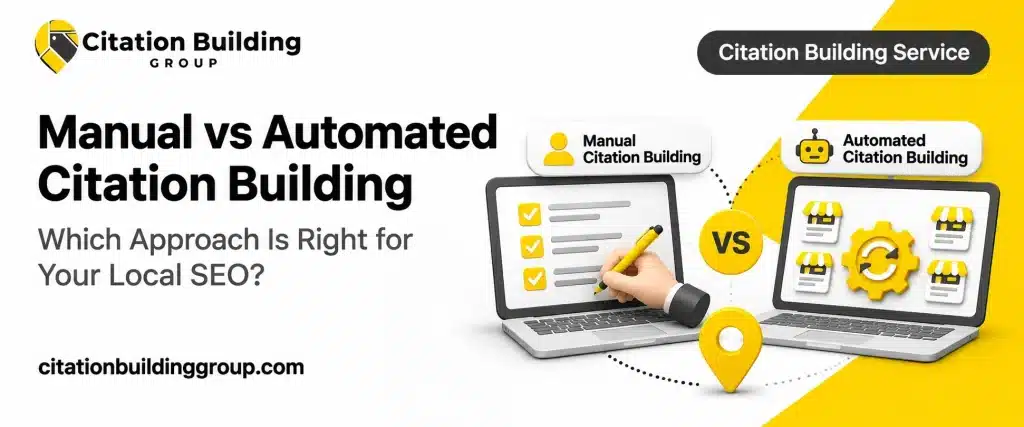
If you run one repair shop and its old phone number still appears online, claiming the affected listings by hand is a sensible first move. If you manage 30 stores that change their hours every holiday, updating every directory separately is harder to justify. The decision between manual vs automated citation building comes down to what changes, how often it changes, and who can fix an error when it reaches customers. This guide from Citation Building Group explains how to make that decision directory by directory. Manual vs Automated Citation Building at a Glance A local citation is an online mention that identifies your business. A directory profile might include your business name, address, and phone number, often abbreviated as NAP. A neighborhood publication might mention your shop by name and street in a story. Both can help a reader find you, but only the directory profile is likely to have fields you can claim, edit, or update through listing management software. With manual citation building, a person finds the appropriate directory, checks for an existing profile, and creates or corrects the listing. With automated citation building, a platform distributes approved business information to supported publishers. Some platforms connect to directories directly. Others distribute records through local data aggregators, which supply business information to other publishers. Decision factor Manual citation submissions Automated citation building Directory coverage You can approach individual local and industry directories. Coverage depends on the provider’s publisher network. Speed Each profile takes time to review, submit, and verify. One change can go to many supported publishers, each with its own publication schedule. Accuracy A person can catch unusual details but can also mistype them. Consistent source data reduces retyping. An incorrect source can repeat the same error across many listings. Access The business can retain direct access where the directory supports it. Direct access and editing rights vary by publisher and provider. Cost Staff time or project fees, plus the cost of future edits. Platform fees, setup time, and staff time for exceptions. Best fit Specialized directories, disputed profiles, and businesses with stable details. Multiple locations, recurring changes, and directories that accept the required fields. When Manual Citation Submissions Are Worth the Time Imagine an independent heating contractor whose best referrals come from a county builders’ association. The association maintains a public directory, but a staff member reviews each application and checks membership before publishing. If a listing platform does not cover that association, buying a larger distribution package still leaves one of the contractor’s most valuable profiles untouched. A manual submission gives the contractor room to answer questions a generic feed may never ask. Does the business serve homeowners, commercial property managers, or both? Does its emergency number reach a technician after hours? Which counties does it actually cover? Someone familiar with the business can choose the correct membership category and supply a description that helps a prospective customer decide whether to call. Claim an existing profile before creating another one Search the directory using the business name, phone number, and any previous address. A company that recently moved might have a profile under its old street address, even if searching the new address returns nothing. Claiming the existing record gives you an opportunity to correct it and preserve the profile customers already recognize. Creating another listing can leave both addresses visible. For each claim, record the public URL, the business-controlled email used for access, the verification status, and the date you checked the published information. Those four details make the work easier to maintain when a staff member leaves or an agency contract ends. For a broader walkthrough of directory selection and submissions, see the guide to local citation building. When Automated Citation Building Saves Real Work Consider a regional retailer that closes early on Thanksgiving Eve. Each store manager confirms local hours, and the marketing team approves the schedule. With a connected listing platform, the team can distribute each location’s hours across publishers that support special hours. The real saving comes the next time the schedule changes, because the team already knows which records belong to which stores. Before making a manual vs automated citation building choice, ask the automated provider for its publisher list for the United States and compare it with the directories your customers actually use. Then check field coverage. A platform might support a publisher’s address and phone fields while offering limited support for appointment links, department hours, or service areas. A publisher logo on a sales page tells you little about which changes you can make. Run a small test before rolling out the system. Choose one location with an approved change, send it through the platform, and open the public listing afterward. Check whether the update appeared on the correct profile and whether other important fields stayed accurate. Record the time between submission and publication. That test is more informative than a demonstration showing how quickly someone can click “sync.” Citation Accuracy vs Scale After a Business Move A move exposes the biggest weakness in either approach. Suppose a dental practice relocates from Suite 210 to a different building across town. Its website shows the new address, a dental association lists the old one, and a map profile contains reviews from patients who visited the original office. A broad submission campaign could distribute the new address while leaving patients free to book directions to the old one. In this situation, the manual vs automated citation building decision starts with identifying which profiles represent the same practice. Search both addresses and the existing phone number. Record which listings have reviews, appointment links, or account access. Also look for practitioner profiles. An individual dentist and a dental practice may share an address while representing different entities. Check the publisher’s rules before requesting a merge or removal. Once you know which records should change, update the approved address in your central record. Use connected tools for publishers that reliably match the correct location. Handle ambiguous matches and ownership disputes individually.